
Warm Weather Working
Advice and guidance for working in hot weather
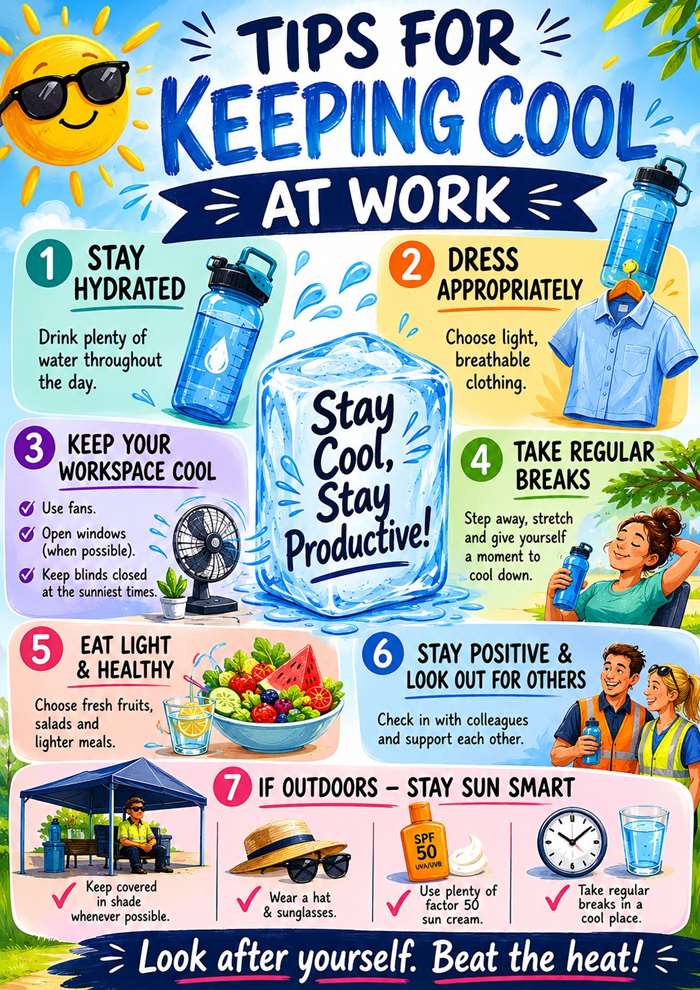
Warm Weather Working
When the weather becomes too warm, it can adversely affect the safety of employees. There is no Maximum Working Temperature specified in the UK. However, employers must take sensible precautions to safeguard their workers, even if this means making temporary working arrangements during heat-waves etc.
Risk Assessment
Hot environments, either those that are always present such as near hot plant or equipment or those caused by extreme weather, must be considered in employers risk assessments and if you have 5 or more employees the risk assessments must be recorded. The information on this page will help employers write their risk assessment and implement suitable and sufficient control measures.
See the HSE website for more information about undertaking a risk assessment.
What is thermal comfort?
Thermal comfort means taking into account a range of environmental, work-related and personal factors when deciding what makes a comfortable workplace temperature.
When people are too hot
You can help ensure people are comfortable in warm conditions:
- Provide fans, such as desk, pedestal or ceiling-mounted ones
- Provide air-cooling or air-conditioning and adequate ventilation
- Ensure windows can be opened to keep air circulating
- Shade employees from direct sunlight with blinds or by using reflective film on windows
- Position workstations away from direct sunlight or sources of heat
- Place insulating materials around hot plant and pipes
- Provide cold water dispensers (water is better than caffeine or carbonated drinks)
Changing work arrangements
- Introduce flexible working patterns, such as job rotation, moving workers to cooler parts of the building where possible
- Allow enough breaks to allow workers to get cold drinks or cool down
- Relax formal dress codes – but make sure personal protective equipment is used if required
Heat Stress
Heat stress happens when the body's way of controlling its internal temperature starts to fail. As well as air temperature, factors such as work rate, humidity and work clothing may lead to heat stress. Se the HSE's advice on Heat Stress.
Working Outdoors
When working outdoors, the weather can have a serious impact on worker’s health if the risks have not been properly managed. This impact may be immediate or occur over a longer time, leading to conditions like skin cancer. The weather can also affect a worker’s ability to keep safe, for example when handling machinery.
There are simple actions you can take to protect people working outdoors;
Hot environments
- Reschedule work to cooler times of the day
- Provide more frequent rest breaks and introduce shading to rest areas
- Provide free access to cool drinking water
- Introduce shading in areas where people are working
- Encourage workers to remove personal protective equipment when resting to help encourage heat loss
- Make sure workers can recognise the early symptoms of heat stress
Working in the sun
Too much sunlight can cause skin damage including sunburn, blistering and skin ageing. In the long term, it can lead to an increased risk of skin cancer.
If work keeps you outdoors for a long time your skin could be exposed to more sun than is healthy for you. Outdoor workers that could be at risk include farm or construction workers, market gardeners, outdoor activity workers and some public service workers. You should take particular care if you have:
- fair or freckled skin that doesn't tan, or goes red or burns before it tans;
- red or fair hair and light coloured eyes;
- a large number of moles.
People of all skin colours should take care to avoid damage to the eyes, overheating and dehydration.
What are the harmful effects?
In the short term, even mild reddening of the skin from sun exposure is a sign of damage. Sunburn can blister the skin and make it peel.
Longer term problems can arise. Too much sun speeds up ageing of the skin, making it leathery, mottled and wrinkled. The most serious effect is an increased chance of developing skin cancer.
What can you do to protect yourself?
- Keep your top on.
- Wear a hat with a brim or a flap that covers the ears and the back of the neck.
- Stay in the shade whenever possible, during your breaks and especially at lunch time.
- Use a high factor sunscreen of at least SPF30 on any exposed skin.
- Drink plenty of water to avoid dehydration.
- Check your skin regularly for any unusual moles or spots. See a doctor promptly if you find anything that is changing in shape, size or colour, itching or bleeding.
-
The following free leaflets have been produced by HSE:
Keep your top on: Health risks from working in the sun (PDF)
The following website also provides useful information:
Last updated: 26 May 2026