
Recording Protest
The covert photography of Arthur Barrett
In October 1903, Emmeline Pankhurst and a small group of women met at the Pankhurst family home at 62 Nelson Street, Manchester, and founded the Women’s Social and Political Union (WSPU).
Five years later, in October 1908, leading suffragettes Emmeline Pankhurst (left), Christabel Pankhurst (right) and ‘General’ Flora Drummond (centre) appeared at Bow Street Magistrates Court. They had been arrested after urging their supporters to ‘rush’ the House of Commons—an act the authorities treated as incitement to riot. The trial thrust the three prominent campaigners into the public eye and marked a more confrontational stage in the fight for women’s right to vote.
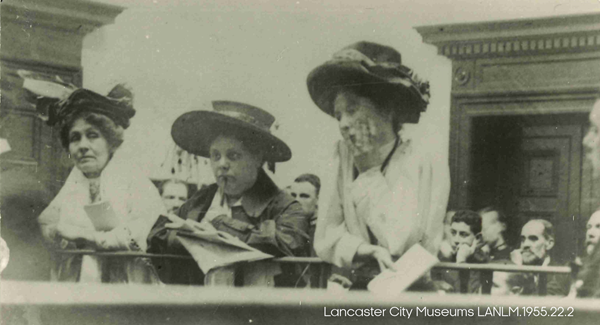
Having studied law at university, Christabel chose to defend herself. She made the most of the opportunity, serving summonses on two Cabinet ministers, Lloyd George and Herbert Gladstone—a bold move that won the suffragettes plenty of press attention. The women were sentenced to three months in Holloway Prison, where Emmeline and Christabel called for imprisoned suffragettes to be recognised as political prisoners. Emmeline was placed in solitary confinement after refusing to follow prison rules. Flora Drummond, aged 30, was nicknamed ‘The General’ for leading women's rights marches in a military-style uniform, complete with an officer’s cap and epaulettes. Often riding a large horse, she certainly knew how to make an entrance. Flora had completed a business training course at a civil service school in Glasgow where she passed the qualifications to become a post-mistress but standing at 5'1" was refused a post because she didn’t meet the new minimum height requirement of 5'2". This discrimination drove her to fight for equality. Flora was released after just nine days when it was discovered that she was pregnant. She led a fascinating life.
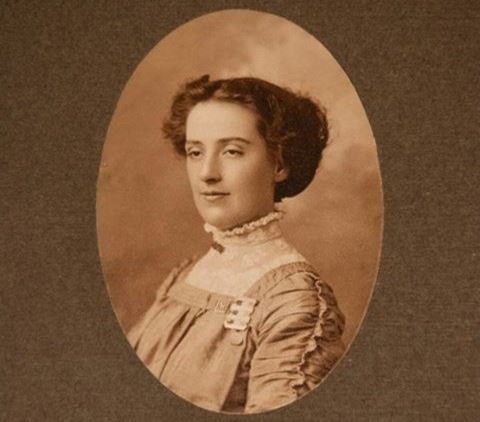
Drummond and the Pankhursts were not the only ones on the front lines. Selina Martin, who grew up in Lancaster, became one of the town’s best-known suffragettes. She joined the Women’s Social and Political Union (WSPU) and was among those arrested on 13 October 1908, when around 60,000 supporters gathered in Parliament Square. As groups of suffragettes tried to push through police lines towards Parliament, Selina was arrested alongside dozens of others and sentenced to one month in Holloway Prison.
The trial photograph has a remarkable story of its own. A stamp on the back of our copy identifies the photographer as Arthur Barrett. Photography inside the courtroom was prohibited—as it still is—but Barrett found an ingenious way around the rule. He hid a small camera inside his top hat, cut a hole for the lens and covered the sound of the shutter with a carefully timed cough. This daring method allowed him to take this photograph and several others, combining technical skill with a touch of defiance. Barrett regularly photographed suffragettes, creating a fascinating visual record of women whose protests, arrests and court appearances became part of the campaign’s public story. His pictures often appeared in the Daily Graphic and Sunday Graphic, bringing these dramatic events—and the suffragettes themselves—to a wide audience. In many ways, Barrett was an early investigative photojournalist, finding creative ways to capture events that the authorities would rather have kept out of sight.
The photograph was widely reproduced for the press, and copies can now be found in several museum collections across the country. Ours was accessioned in 1955, securing a permanent record of this extraordinary moment in history for the appreciation of our local community and visitors.

