
Insus Tombstone
In 2005, during the construction of residential flats in Lancaster, builders made a dramatic discovery. Buried underground were the damaged but incredibly detailed remains of the tombstone of a Roman cavalry soldier; one that would prove to be a rare depiction of triumph over the enemy.
As soon as the stone was identified as an archaeological find, a team from the University of Manchester Archaeological Unit were called in to investigate. Their work began to reveal a story that had been hidden for two millennia; the story of an auxiliary cavalryman named Insus. The discovery of his spectacular memorial has vastly enriched our knowledge of Roman Lancaster and allowed us to understand more about the lives of soldiers stationed at the far reaches of the Roman Empire.
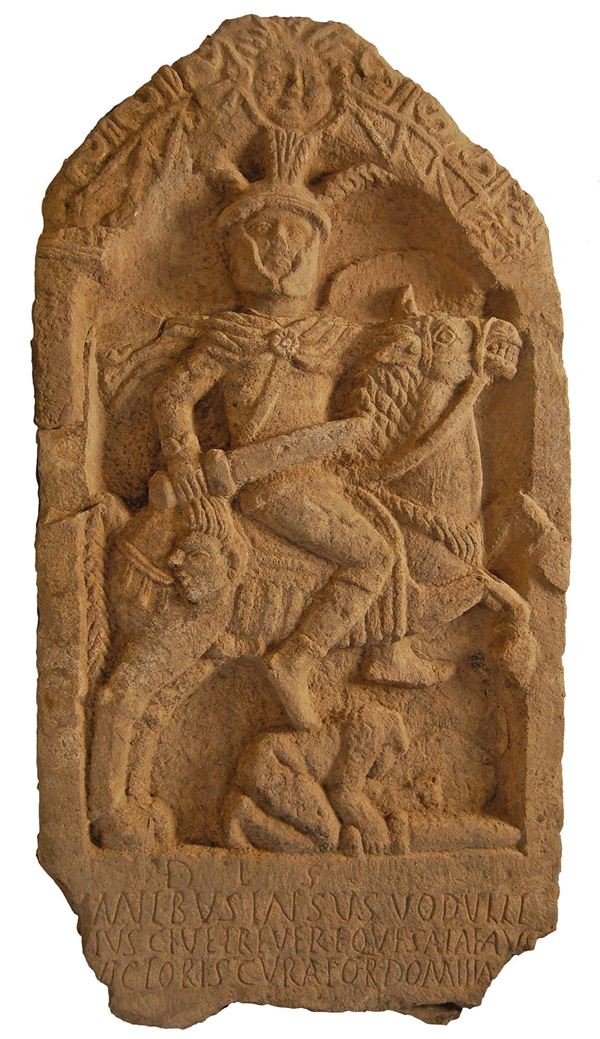
Now one of Lancaster City Museum’s most popular exhibits, the Insus tombstone is carved from sandstone and is thought to date from the first century, around 75-100 CE (AD). It’s a memorial rather than an actual tombstone, found without any burial remains. The design is a remarkably rare ‘Reiter’ or ‘rider’ type. It depicts a mounted cavalryman in action with the decapitated head of an adversary in his hand, and the body at his horse’s feet. Such violent imagery may have emphasised imperial power in remote areas. It may also have drawn a distinction between the non-citizen soldier and the local population. Only about 23 Reiter tombstones have been found across Roman Britain, and 150 in the entire western Roman empire. Most other memorial stones or stelae are simplistic in design, and even those are relatively rare. The majority of funerary monuments were probably made of more affordable but less durable materials such as wood, and these no longer survive.
Standing at seven feet high and three feet wide, the Insus memorial is hewn from a kind of local sandstone called millstone grit. The fact that it is made of this stone shows that it was likely created in the Lancaster area. The figurative detail is well executed, but the inscription less so, suggesting that perhaps the carving and the inscription were done by different people.
The inscription reads:
DIS
[M]ANIBVS INSVS VODVLLI
[FIL]IVS CIVE(S) TREVER EQVES ALAE A VG
(T] VICTORIS CVRA TOR DOMITIA [HF C]
This has been translated as:
TO THE GODS OF THE UNDERWORLD:
INSUS, SON OF VODULLIUS,
A TREVERAN CITIZEN, A TROOPER IN THE ALA AUGUSTA,
CURATOR OF THE SQUADRON OF VICTOR. DOMITIA, HIS HEIR, WAS RESPONSIBLE FOR THE ERECTION OF THIS TOMBSTONE.
This inscription and the image on the stone give us several clues as to the identity and background of the rider.
Insus was from the Treveri tribe, which places him as originating from western Germany. The Treveri were known for their horsemanship, so Insus and his compatriots may have already been experienced cavalrymen before joining the Roman army. The title Curator has been taken to mean that Insus was a junior officer, or the decurion’s second-in-command. His regular duties would have included a variety of administrative tasks, such as dealing with supplies and disciplinary records. His pay would have been double that of an ordinary cavalryman.
As on most Roman tombstones, the inscription names an heir. This was the person responsible for fulfilling the wishes of the deceased and organising the construction of a memorial. Insus’s heir was a woman named Domitia. The grandeur of the monument suggests that she, or Insus, had access to significant funds. We don’t know her relationship to Insus. She may have been his wife or partner, a relative, or a friend. She may have been a British woman, or travelled here from Germany with Insus, or she may have come from an entirely different part of the empire.
Because Insus is only referred to by a single name, we know that he was not a Roman citizen. This wasn't unusual - in the 1st century, only about 10% of the population of the Roman Empire were full citizens. After the Emperor Augustus reorganised the army in 27 BC, a large portion of the Roman Imperial forces consisted of non-citizen troops known as auxilia (auxiliaries). Joining the auxilia was a way for people in the outlying provinces to earn their Roman citizenship, awarded after 25 years of military service. The Ala Augusta was one such auxiliary unit, and the carved image on the stone depicts Insus equipped in typical auxiliary fashion. The helmet he wears is an auxiliary cavalry helmet with enveloping cheek pieces and a brow reinforcement which was common in the 1st century. It also appears to have a central crest with plumes mounted to droop over. Insus is wearing breeches and a cloak that billows behind him and is fastened at the chest by a circular brooch. Like other stelae found in Britain which honour the lives of auxiliary soldiers recruited from various parts of the Empire, this depiction serves not only to commemorate Insus’s life, but also to immortalise him with an idealised, Romanised identity.
At the top of the tombstone you can see the head of a Medusa, whose gaze turned anyone who dared look at her to stone - including Insus, his horse and the decapitated enemy. One further decoration used are oak-leaves. In the Roman world, the oak-leaf crown was awarded for bravery.
Take a look at this 3D model of the tombstone, which was created during an Oxford University project called LatinNow.
Read more about Roman Lancaster on our local history pages.
More Roman artefacts are on display at both Lancaster City Museum and Lancaster Maritime Museum. You can also visit the remains of the Roman Bath House in Vicarage Field on Lancaster's Castle Hill.

