
Roman Lancaster
Roman Lancaster never ceases to fascinate. Long before the medieval castle dominated our skyline, a Roman fort stood for centuries on the same site. The very name of the city describes this fort (-caster) on the River Lune (Lan-). But today, over 1,600 years after the Romans departed, it takes a combination of archaeological discovery, academic research and local enthusiasm to piece together the story of day-to-day life here on the northern frontier of the empire.


Before the Romans arrived, the powerful Brigante tribe controlled the Lancaster area and much of northern England. Roman forces advanced into this region about 30 years after they’d first landed on the south coast. In the early 70s CE* the Roman governor of Brittania, Petilius Cerialis, established a turf and timber fort here as a base for the occupying forces in this newly conquered land. The chosen site overlooked the lowest crossing point of the River Lune from the top of what is now known as Castle Hill. This location was no accident. The Romans may be best known for their roads, but they used ships for transport and travel too. Downstream from here the River Lune is navigable, giving access to Morecambe Bay and the Irish Sea. Upstream, the river can be forded in many places. The hill gives a good view of the area for miles around, and the Roman engineers and soldiers who stood here and looked out over the landscape nearly two millennia ago certainly knew the strategic value of this spot. The fort gave them control of the river crossing and served as a base for land and sea patrols of the area, as well as a link between the military hubs of Chester to the south and Hadrian’s Wall to the north.


Although the Romans were great record keepers, few documents have survived into the present day, so there are many gaps in our knowledge. We don’t know, for instance, what name the Romans used for this fort. Some historians suggest it may have been known as Galacum, Calunia or Lulun. (Like ‘Lancaster’, the last two of these names seem to be based on the name of the River Lune – itself probably an ancient British word meaning ‘clean’ or ‘healthy’.)
By the mid-70s the Brigantes must have been quelled, as attention appears to have been switched to Wales. The new governor of Britannia, Gnaeus Julius Agricola, campaigned there in 77 CE. Here in Lancaster the local inhabitants began to settle into life under Roman rule. A vicus (village) soon grew up outside the fort to house British families, shopkeepers, innkeepers, merchants and camp-followers, attracted by the easy money to be made from the soldiers. The layout of the modern city centre is a direct inheritance from this early Romano-British settlement, which was connected to the fort by a road running downhill from the main East Gate along what is now Church Street.
Trade was key to the interactions between the inhabitants of the fort and the vicus. Every arrival of a military unit in need of provisions would have offered the locals the chance to sell goods and services, and increased their contact with the Roman army. The construction of roads and the influx of imperial currency created new opportunities for commerce and travel. Roman docks built on the river allowed exotic goods to be shipped in from across the empire.

Ancient written records tell us little of domestic life in the vicus for civilian men, and even less of women. But archaeological finds in this area can help to shed light on how the lives of occupying soldiers became entwined with those of local people. Until the Severan dynasty (193 CE – 235 CE), regular Roman soldiers weren’t legally allowed to marry whilst in service, but in practice this was not easily enforced. Soldiers would often form bonds with local women and raise families with them within the vicus. These unofficial partners would mostly have run the home and raised children. Domestic tasks included spinning, weaving, washing, preparing and cooking meals, and maintaining the household shrine.
More senior Roman officials may have brought their wives and families to Britain from elsewhere in the empire, and for them, life would have been very different. They had a more leisured existence, with slaves carrying out domestic tasks on their behalf. The women may have instead been responsible for hosting events and feasts, as well as keeping up with the latest aesthetic trends from the heart of the empire. Evidence from the northern frontier has revealed that women who moved to Britannia with their husbands sometimes formed meaningful friendships with other women in similar situations. Such bonds may have brought solace to women living in or near military zones during uncertain times.

Over time the vicus grew into a Roman-style town complete with paved roads and stone buildings, the remains of which still lie beneath our streets today. A glimpse of one of these is visible today on Castle Hill, where a substantial Roman bathhouse was uncovered in the 1970s. It was probably part of a private residence or courtyard house, likely for a roman official.
Trade, personal relationships and Roman infrastructure all contributed to the gradual Romanisation of the local population, but here on the extreme fringe of the empire there was never a complete transformation. Unlike the south and east of Brittania where Roman villas were common, the militarised north seems to have largely retained a traditional British way of life. Nor was Romanisation a one-way process, since imperial policy and custom favoured cultural exchange. This is clear when looking at evidence of religious worship, where a fusion of beliefs characterised Roman Britain. In many cases the Romans identified local gods as versions of their own, merging their names to create hybrid deities. Sulis Minerva is a famous example from Bath, where the Roman goddess Minerva was linked with the local deity Sulis. A sandstone altar found on Lancaster's Castle Hill and now displayed inside the castle also demonstrates this practice. It’s dedicated to Mars Cocidius: Mars, the Roman God of war and hunting, was identified with the Celtic god Cocidius. This approach helped smooth the way for the Romans to assimilate local people into their own culture without offending them - or their gods.

Early in the 2nd century, Lancaster’s Roman fort was rebuilt in stone, extended northwards, and turned 90 degrees to point north. This may have been because new forts had been established in the Lake District since the withdrawal of Roman forces from Scotland, and a timber bridge was built over the River Lune to carry a road north towards them.
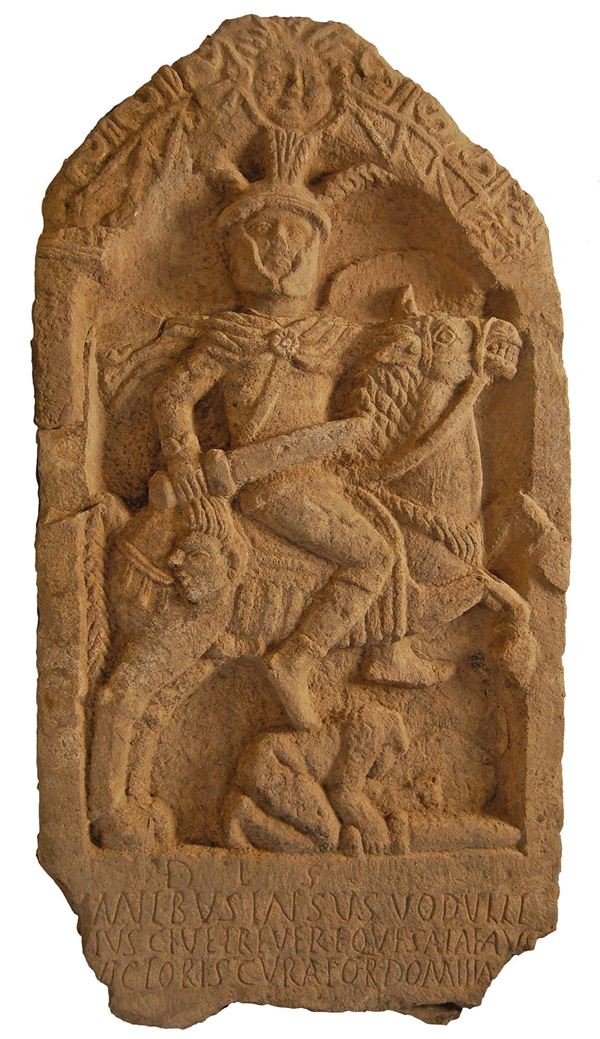
In this era the fort housed an elite cavalry unit, the Ala Augusta. Although the Roman Empire is famous for its legions, these citizen-soldiers made up only a small part of the army. Most military units, including the Ala Augusta, were auxiliaries. These were troops who were not Roman citizens, but supported the legionaries and specialist troops. They were recruited from all over the Roman Empire and were mostly volunteers looking to gain Roman citizenship after 25 years of military service. Men serving in the Ala Augusta in Lancaster guarded the frontier. They could also be tasked with going ahead of the legions to locate potential campsites, sources of food and water, and to investigate the land ahead of battle. With less armour and equipment than legionaries, their mobility made them ideal for patrolling, containing raids or rebellions, and enforcing Roman taxation.
A spectacular memorial stone discovered in 2005 and now displayed at Lancaster City Museum gives us some insights into the story of one cavalryman from this unit, a man named Insus. The inscription tells us that a woman named Domitia was responsible for putting up the tombstone, and that she was his legal heir. Because Insus was an auxiliary and is only referred to by a single name, we know that he was not a Roman citizen. He was a member of the Treveri tribe, hailing from the area around Trier in modern day Germany. The Treveri were known for their excellent horsemanship, so Insus and his compatriots may have already been experienced cavalrymen before joining the Roman army.
Lancaster’s fort was reconstructed again in the middle of the 4th century with stronger stone walls and defensive bastions. This may have been because it was one of a handful of shore forts, built to protect against seaborne raiders. The new fortifications were massive, up to 6 metres high and 4 metres thick. Long after the Roman Empire withdrew from Britain, the remains of this wall continued to be used for protection by the local Britons and later Anglo-Saxon settlers. A fragment still stands on the eastern slope of the hill, and it’s known to this day as the ‘Wery Wall’, probably from the old English werian – to protect.

Even after the wall was gone - its stones likely re-used for other buildings in more peaceful times - the site of the Roman fort lost none of its significance. The area remained a seat of power and worship for millennia, transitioning from a fortified stronghold to an early medieval minster, and eventually to the medieval castle and priory church we see today.

Modern technology and community archaeology are still adding pieces to the puzzle of Lancaster’s Roman past. You can find more details in these two reports which highlight the ongoing process of investigation that has taken place over the last 100 years:
This recent report by Jason Wood of Heritage Consultancy Services was commissioned by Lancaster City Council to gain a full understanding of the work that had already taken place on site. The council has set up an expert advisory group that is helping to develop a research framework for the fort site and related adjacent areas so that priorities for future investigation can be decided based on what we know so far and following consultation with archaeological professionals, academics, heritage groups and members of the public. The report draws together the archaeological work that has taken place, providing a comprehensive overview of work to date with a focus on the Roman heritage of the site. This analysis ends with the exciting news that geophysics has brought to light what is very likely to be a Romano-Celtic temple. If true, this will be only the second to be discovered in the North of England – the other being at Vindolanda on Hadrian’s Wall.
This earlier report by the Lancaster and District Heritage Group details the excavation that was undertaken in 2015 on part of what is now thought to be a Romano-Celtic temple - before the geophysics revealed the rest of the building. It demonstrates the process of discovery and understanding that takes place as further pieces are added to the puzzle and the importance of recording as much detail as possible and of undertaking post-excavation analysis. In the light of the geophysics it can now be returned to with fresh eyes.
*Note on dates: Years in this article are written as CE (Common Era) instead of AD (Anno Domini). 2026 CE is exactly the same year as 2026 AD. CE is just a secular alternative often used to avoid religious connotations.

