
Grave memorials
Memorial Regulations
There are certain restrictions upon memorials, depending on the section that the grave is located. It is important that you are aware of these regulations in order to be able to arrange for the appropriate memorial for the grave, and to avoid any potential issues in the future with valuable or sentimental items.
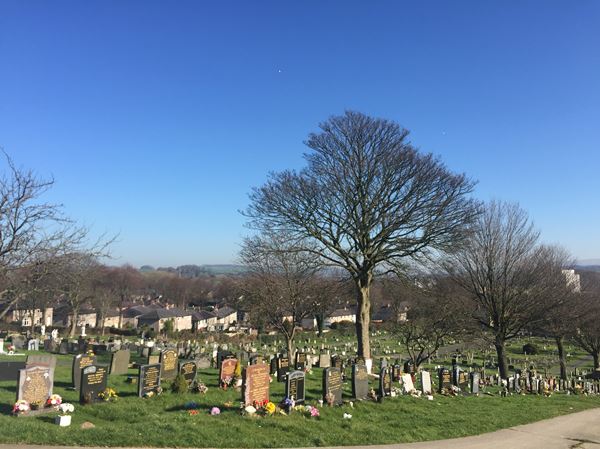
Lawn Graves: Lawn sections were established to retain a lawned, green space within our cemeteries. The purpose is to provide grave rights holders with a sufficient area to memorialise and pay tribute to their loved ones, whilst retaining unrestricted access for the preparation of graves and to allow maintenance of the grounds. On Lawn Sections, the following regulations apply:
- Standard memorials are permitted at the top of the grave, subject to a memorial permit being obtained from the Cemeteries Office. Memorial permits can be obtained by your chosen memorial mason as part of their application. Memorials, including concrete foundations and plinths, must not exceed 4’ in height, 3’ in width and 1’6” in depth from front to back.
- All graves will be level with the surrounding ground. No kerbs, border stones, tiles, slates, raised mounds, turf bankings, wooden, plastic or metal installations of any kind will be permitted.
- As we recognise the importance of placing mementoes on a grave, we also allow an area of 18” from the base of the memorial stone for personal memorialisation. If the grave owner wishes, they may remove the turf in this area and plant spring bulbs, bedding plants or sow native wildflower seed. Shrubs, trees or any other type of large or fast-growing plants are not permitted as they interfere with grave access and preparation, and will need to be removed. Other than as stated above, no turf may be dug out or removed from the grave or other planting permitted.
- This 18" area may also be used for mini kerbs, engraved tablets or inscribed vases, subject to a memorial permit being obtained from the Cemeteries Office
Traditional Graves: Traditional graves were offered when the cemetery was first established. In these sections:
- Standard memorials are permitted at the top of the grave, and within the full grave boundary, subject to a memorial permit being obtained from the Cemeteries Office. Memorial permits can be obtained by your chosen memorial mason as part of their application. Memorials, including concrete foundations and plinths, must not exceed 4’ in height, 3’ in width and 1’6” in depth from front to back.
- If a full border or kerbs are installed upon the grave, the grave rights holder is permitted to utilise this area to place small mementoes or floral arrangements.
- Please note that for any additional inscribed/engraved items, a memorial permit is required from the Cemeteries Office.
Woodland Graves: Our Woodland was established to create a natural environment for those who wished to be buried within nature and for graves to appear unmarked. Graves themselves are plotted and registered on an plan of the section, and small markers are installed in each grave to allow identification by the Cemeteries Office. Within our woodland:
- Memorials are not permitted to mark graves under any circumstances.
- This includes fixed or temporary items, wooden markers/crosses, floral arrangements, or any other item which clearly defines the grave.
- The Cemeteries Office do appreciate that on certain anniversaries that loved ones may wish to place items. Therefore we do allow natural floral tributes to be placed on the grave, providing that all plastic or non-biodegradeable material has been removed first. Flowers are not permitted in vases or pots of any kind. We politely request that these flowers are removed once withered.
- In addition, we ask that visitors refrain from placing bird feeders/bird baths etc within the woodland area.
The Cemeteries Office has the authority to remove, without notice, any items placed on or around a grave which contravenes these Regulations. Items will be respectfully re-sited where possible to the correct position on a grave. If no space is available, or the grave rights holder does not agree to items placed by another individual, they will be removed from the grave.
As it is a public open space, any items placed in the Cemetery are done so at the owner’s risk. Grave rights holders should seek appropriate insurance on any fixed memorial as they see fit.
Lancaster City Council will maintain the turf on each grave free of charge. Please do not lift the turf, or otherwise restrict the growth of grass. Our office will level ground and sow grass seed where necessary.
Applying for a memorial
Fixed memorials
A fixed memorial is an inscribed vase, tablet, or memorial stone which is intended to remain upon a grave indefinitely.
In order to arrange the installation of a fixed memorial upon a grave, applicants must first obtain permission from the grave rights holder. This is provided by producing the original Grave Deed document to the selected memorial mason. Scanned or photographed documents are not accepted - only the original document is proof of grave rights ownership.
The applicant should approach a registered memorial mason of their choosing. The Cemeteries Office has in place a list of Registered Memorial Masons, who have been approved to work within our council Cemeteries. Lancaster City Council’s Memorial Mason Registration Scheme is in place as a measure to ensure the safety of all our cemetery users, and also to provide the memorial applicant with reassurance that the memorial work will be completed to a high standard. Only memorial masons registered with this scheme may carry out work to memorials within any of the Lancaster City Council managed Cemeteries. This list can be obtained by contacting the Cemeteries Office by email: cemeteries@lancaster.gov.uk, or telephone: 01524 582635.
All successful applicants to the memorial mason scheme must carry out any memorial work safely, by competent masons, who are suitable insured and who work to nationally recognised standards.
Any memorial masons wishing to join the scheme should be prepared to make the necessary application, which includes proof of their liability cover, proof of their NAMM or BRAMM accreditation, details of references, and administration payment. Any potential applicants should contact the Cemeteries Office directly.
Temporary markers
These are grave markers such as inscribed wooden crosses, or similar which are intended to mark the location of a grave until such a time as a fixed memorial is arranged.
Inscribed or engraved items may only be placed with the permission from the grave rights holder.
A memorial mason is not required for these type of memorials - they can be obtained directly from a supplier by the applicant. The applicant must contact the Cemeteries Office directly to complete the appropriate application and allow permission for the marker to be installed.
Memorial Items
Memorial items, mementoes and flowers should only be placed upon, or removed from, a grave at the express permission of the grave rights holder. The Cemeteries Office reserve the right to remove items which are offensive to cemetery users, or which the grave rights holder has not approved.
Items should not extend beyond the grave boundaries (or 18" from the memorial site on lawn graves), so as not to impact on nearby graves, cemetery visitors or staff.
Under no circumstances are balloons permitted to remain on graves, or to be released in the cemetery. Balloons will cause a detrimental impact to our environment, and there are appropriate alternatives to such memorialisation.
Overall, the Cemeteries Office take a flexible approach to items placed upon graves and we would request that grave rights holders use their own judgement as to what type of items are suitable. Please note that items left on graves are the responsibility of the grave rights holder.
Should grave owners wish to add living wreaths (such as moss/holly etc) to the graves over the Christmas period, we ask that they are removed by the end of January. After this time, and following a period of notice within the cemeteries, Grounds Maintenance staff will remove and discard such items.
Memorial Safety
Whilst the Cemeteries Office is responsible for maintaining a safe environment within the cemetery, the Grave Deed Owner has the responsibility to maintain the memorial itself in a safe condition.
Memorials must conform to cemetery regulations with regard to size and fixings, and comply to BRAMM British Standard 8415. As a responsible burial authority, we are committed to protecting our public spaces, and ensuring the safety of all those that visit.
Only BRAMM registered memorial masons may apply for our Memorial Mason Registration Scheme, as this provides the applicant and ourselves as burial ground managers with confidence that the mason is qualified to the highest standards. The registration scheme also confirms the memorial mason's appropriate insurance cover, risk assessments, and references.
Once accepted onto the scheme, memorial masons may submit a permit request for a proposed memorial. This application must stipulate the type of memorial, material, measurements, inscription, and permission from the grave rights holder. If approved, they will be issued with a permit to work in the cemetery, and met on site by a member of our team. This ensures that the memorial will be sited and installed correctly.
Once installed, all memorials will be assessed for stability under health and safety regulations, as well as ensuring that it will be erected in a safe manner. This helps to protect the memorial for the grave rights holder, but also mitigates any potential danger for any person in the cemetery. Information will be installed in the cemetery to provide adequate notice and details of when assessments are due to be carried out. Memorial inspections are conducted by a trained and qualified member of the Cemeteries Office staff. During a safety inspection, if a memorial is found to be:
- Safe: this is recorded and no action will be taken at that time.
- Unstable: If appropriate, the memorial will be reinforced by using wooden supports and banding. A notice will be placed to advise the grave rights holder, and the details of the issues will be recorded. The grave rights holder must then decide whether to seek repair from a memorial mason, before the stone further deteriorates.
- Unsafe: In extreme circumstances, and if the memorial cannot be stabilised by the above measure, the stone will be laid flat on the ground. This measure will only be taken if the memorial is at risk of falling and without action could cause serious injury or a fatality.
The grave rights holder is responsible for the maintenance of the memorial. If they fail to do this, the Cemeteries Office may take action to make the memorial safe.
Your chosen memorial mason will be able to advise you further, and please contact the Cemeteries Office if you require further assistance.
A list of Memorial Masons currently registered to work in our cemeteries can be found here (PDF, 226KB).
The applicant should approach the chosen memorial mason directly, to discuss requirements. Please note that the memorial mason will require proof that the grave rights holder provides their permission for the installation - please be prepared to provide them with the original grave deed which will be submitted to the Cemeteries Office with their application. Once this office has registered sight of the grave deed, it will be returned to the applicant.
A copy of our Memorial Inspection Procedure can be viewed here (PDF, 74KB).
Last updated: 02 July 2026